


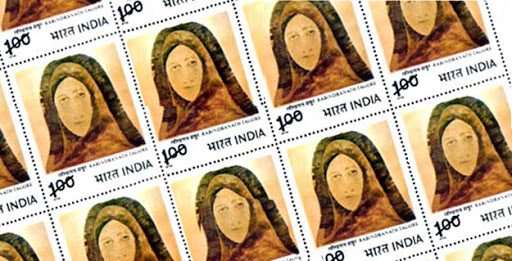
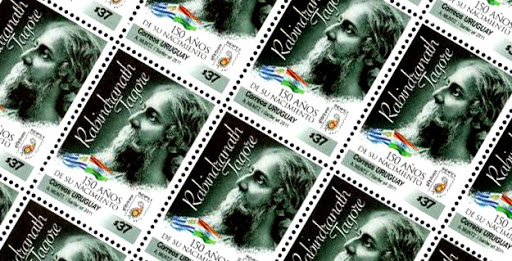
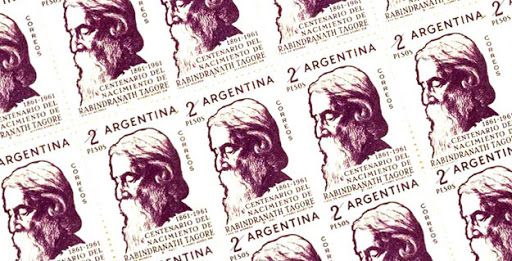
| | Rabindranath Tagore Self Portrait Stamp Released By India Post |
| Nobel Laureate Rabindranath Tagore apart from touching people’s heart with his words , Rabindranath Tagore gave a new dimension to Indian art with his paintings . Rabindranath Tagore’s career as a painter peaked in the first half of the 1920’s . Rabindranath Tagore painted close to 2,500 paintings and exhibited them across India, Europe and Asia. During this time Rabindranath Tagore also authored many sensitive writings on art and aesthetics, apart from the setting up of Kala Bhavana . In 1900, discussing the paintings of J.P.Ganguly based on Banabhatta’s Kadambari , Rabindranath Tagore endorsed the practice of combining Indian historicist themes with realist rendering of Western lineage. |
| Stamp Of Abanindranath Tagore’s Painting Of Abhisarika | During the start of the 19th century, India started saw a new nationalist surge in the sphere of art . The Surge was led by Abanindranth Tagore and E.B. Havell, the Calcutta Art School was of the belief that it was essential for the Indian artists to take in Western representational methods for the progress of Indian art |
| The art activities reached peak with E.B Havell taking a decision to introduce Indian art into the Calcutta Art School and replace the European collection and with the original examples of Indian art . Rabindranath Tagore supported E.B Havell . |
| | |
| Rabindranath Tagore in 1891, pushed Abanindranath and Nandalal Bose to take notice of the larger cultural panorama . Rabindranath Tagore invited Abanindranath Tagore and Nandalal Bose to Kala Bhavana thereby making sure that Santiniketan remained the Centre of this new art movement.
The fact that Tagore was deeply impressed by Stella Krammrisch can be gauged from his attending Stella Krammrisch’s lecture in London in 1920. Rabindranath Tagore invited Stella Krammrisch to Santiniketan in 1922, where Stella was part of discussions on World Art from Gothic to Dadaism.Rabindranath Tagore himself took special interest in these lectures and translated them . In 1921, Tagore also visited Weimer and Bauhaus in Germany and met Kollowitz, Modigliani,Johannes Itten.
Rabindranath Tagore’s visits to the British Museum also exposed him to primitive art , a form that he would encounter in his travels to Indonesia, China and America.Rabindranath Tagore’s fascination for geometrical shapes can be manifested in his painting featured On Indian Stamp On Modern Paintings released In 1978 . |
| | |
| | |
| | |
| | |


0 comments:
Post a Comment